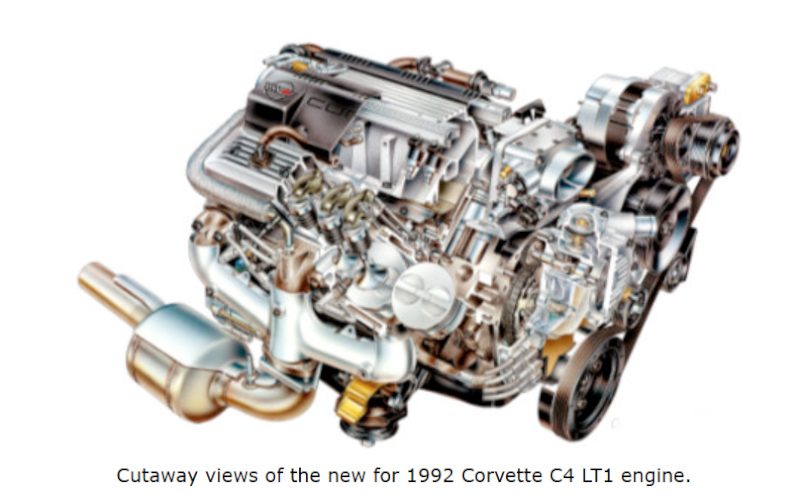
1992/1993 LT1 VS 1996
The 1992–1993 and 1996 Chevrolet Corvette C4 models are equipped with variants of the LT1 engine, a 5.7L V8 small-block engine. While the core architecture of the LT1 engine remains consistent across these model years, there are notable differences in components and systems, including the Mass Air Flow (MAF) sensor, fuel injectors, Engine Control Module (ECM), and other related systems.
Below are the engine differences, focusing on the specified components and other relevant changes — such as; 1. Mass Air Flow (MAF) Sensor1992–1993 LT1 (Speed-Density System):The 1992 and 1993 LT1 engines use a speed-density fuel management system, which does not incorporate a MAF sensor. Instead, they rely on a Manifold Absolute Pressure (MAP) sensor, along with inputs from engine RPM, throttle position, and temperature sensors (Manifold Air Temperature and Engine Coolant Temperature), to calculate air intake and fuel delivery. This system calculates airflow indirectly, which can be less accurate than a MAF-based system, especially if there are vacuum leaks or modifications affecting manifold pressure.
1996 LT1 (Mass Air Flow System): Starting in 1994, the LT1 engine transitioned to a Mass Air Flow (MAF) system with sequential fuel injection, which continued through 1996. The MAF sensor directly measures the mass of air entering the engine, providing more precise fuel metering, improved performance, better fuel economy, and lower emissions compared to the speed-density system.
The 1996 LT1 uses a MAF sensor in conjunction with a MAP sensor, the latter serving as a backup for diagnostics (e.g., monitoring EGR function and enabling “limp-home” mode). A typical MAF sensor reading on a 1996 LT1 should be around 6–9 grams/second at idle, as measured by a scan tool.
Impact: The switch to a MAF-based system in 1996 (starting in 1994) allows for more accurate air-fuel ratio control, which enhances drivability and supports stricter emissions requirements. However, MAF sensors can become contaminated (e.g., by dirt or oil from aftermarket air filters), potentially causing lean conditions or misfires if not maintained.
2. Fuel Injectors1992–1993 LT1: These model years use batch-fire fuel injection, where injectors fire in groups (all injectors on one bank fire simultaneously) regardless of the intake valve’s position. This is less precise, as some fuel may wait in the intake port until the valve opens, potentially leading to less efficient combustion.
Stock injector size for 1992–1993 LT1 engines is 22 lb/hr.
1996 LT1: The 1996 LT1 employs sequential fuel injection (SFI), introduced in 1994, where each injector fires independently, timed to the corresponding cylinder’s intake stroke. This provides more precise fuel delivery, improving fuel atomization, combustion efficiency, emissions, and performance.
Stock injector size for the 1996 LT1 is 24 lb/hr, slightly larger than the 1992–1993 models to accommodate the sequential injection system and slight performance tuning differences.
Note: The 1996 LT4 (a high-performance variant available in special-edition Corvettes) uses 28 lb/hr injectors to support its higher output of 330 hp compared to the LT1’s 300 hp.
Impact: The sequential injection in 1996 offers better performance, fuel economy, and emissions control compared to the batch-fire system of 1992–1993. The larger 24 lb/hr injectors in 1996 support the refined fuel delivery system. Using larger-than-stock injectors (e.g., 26 lb/hr) in a 1992–1993 LT1 without tuning can lead to over-fueling and requires ECM reprogramming.
3. Engine Control Module (ECM)/Powertrain Control Module (PCM)1992–1993 LT1: These models use an OBD-I ECM (GM service #16159278), which relies on a PROM (Programmable Read-Only Memory) chip and a Memcal for vehicle-specific calibration. This ECM supports batch-fire injection and speed-density fuel control.
The ECM is less advanced in diagnostics compared to later systems and does not support real-time flash reprogramming. Tuning requires physically swapping the PROM or Memcal chip.
The ECM is specific to 1992–1993 models and is not directly interchangeable with later models without significant wiring and programming changes.
1996 LT1: The 1996 LT1 uses an OBD-II PCM (GM service #16188051, introduced in 1994), which is a more advanced flash-programmable module. It supports sequential fuel injection, MAF-based fuel control, and enhanced diagnostics, including misfire detection via crankshaft position monitoring.
The PCM includes a removable knock module under a small access cover, which adjusts ignition timing to mitigate engine knock. This module must be transferred to a replacement PCM during service.
Converting a 1992–1993 Corvette to a 1996 OBD-II PCM is complex, requiring a complete engine wiring harness change and injector rewiring due to the shift from batch-fire to sequential injection. This is rarely practical without professional expertise.
Impact: The 1996 PCM offers superior diagnostic capabilities and tuning flexibility due to its flash-based programming and OBD-II compliance. The 1992–1993 ECM, while reliable for its time, is more limited and harder to tune without physical chip changes.
4. Optispark Ignition System1992–1993 LT1:These models use the first-generation unvented Optispark ignition system, a front-mounted optical distributor driven by the camshaft. The unvented design is prone to moisture buildup, leading to corrosion, arcing, and misfires, especially in humid conditions. This is a known weak point, with distributor caps typically requiring replacement after about 60,000 miles.
The Optispark uses a single-pin drive system to connect to the camshaft, which is less robust and can cause wear or misalignment over time. It is not interchangeable with later models without camshaft or drive mechanism modifications.
1996 LT1: The 1996 LT1 features an improved vented Optispark system (introduced in 1994), which includes a vacuum line and air intake to expel moisture and ozone, significantly improving reliability and reducing misfire issues. The vented design also has better sealing to prevent oil leaks and environmental contamination.
The 1996 Optispark uses a splined drive system, which is more durable and precise than the single-pin system, reducing wear and misalignment. This makes the 1994–1996 Optispark units incompatible with 1992–1993 engines unless the camshaft or drive mechanism is modified.
Impact: The vented Optispark in 1996 is a significant improvement over the 1992–1993 unvented design, offering better reliability and fewer moisture-related failures. Upgrading a 1992–1993 LT1 to a vented Optispark requires camshaft or drive system changes, which can be costly.
5. Other Engine DifferencesCamshaft: The 1992 LT1 has a slightly different camshaft compared to the 1993 model, with the 1993 cam contributing to a slight increase in torque (330 lb-ft in 1992 vs. 340 lb-ft in 1993). The 1996 LT1 retains the 1993 camshaft profile, maintaining the 340 lb-ft torque rating. The camshaft differences are minor but affect low-end torque characteristics.
Serpentine Belt: Early 1992 LT1 engines used a double-sided serpentine belt with ridges on both sides and a slightly different routing. By mid-1993, GM switched to a single-sided serpentine belt, which continued into 1996. This change simplifies maintenance, but parts are not directly interchangeable between early 1992 and later models.
Horsepower and Torque: All LT1 engines from 1992–1996 produce 300 hp at 5,000 RPM, but torque increased slightly from 330 lb-ft at 4,000 RPM in 1992 to 340 lb-ft at 4,000 RPM in 1993–1996 due to the camshaft tweak and fuel injection improvements. The 1996 LT4 (special-edition models) produces 330 hp and uses different heads, intake manifold, and injectors.
Cooling System: All LT1 engines (1992–1996) use a reverse-flow cooling system, which cools the cylinder heads first to allow a higher compression ratio (10.4:1) and improved performance. There are no significant cooling system differences between 1992–1993 and 1996, though the 1996 model benefits from minor refinements like an optional 160-degree thermostat for lower operating temperatures.
Cylinder Heads: The 1992–1996 LT1 engines in Corvettes use aluminum cylinder heads, while other applications (e.g., Caprice, Roadmaster) use cast iron heads. There are no major head design changes between 1992–1993 and 1996 LT1 engines, but the 1996 LT4 has improved heads with larger ports and a different intake manifold.
Exhaust System: The 1996 LT1 includes a more refined exhaust system to meet stricter OBD-II emissions requirements, including a post-catalytic O2 sensor for misfire detection. The 1992–1993 models lack this sensor due to OBD-I compliance. Aftermarket exhaust modifications on 1996 models must account for O2 sensor placement to avoid fuel trim errors.
Valve Covers: The 1992 LT1 uses silver-colored aluminum valve covers, while the 1993–1996 models use black valve covers. This is a cosmetic difference with no performance impact.
Summary Table Component/System
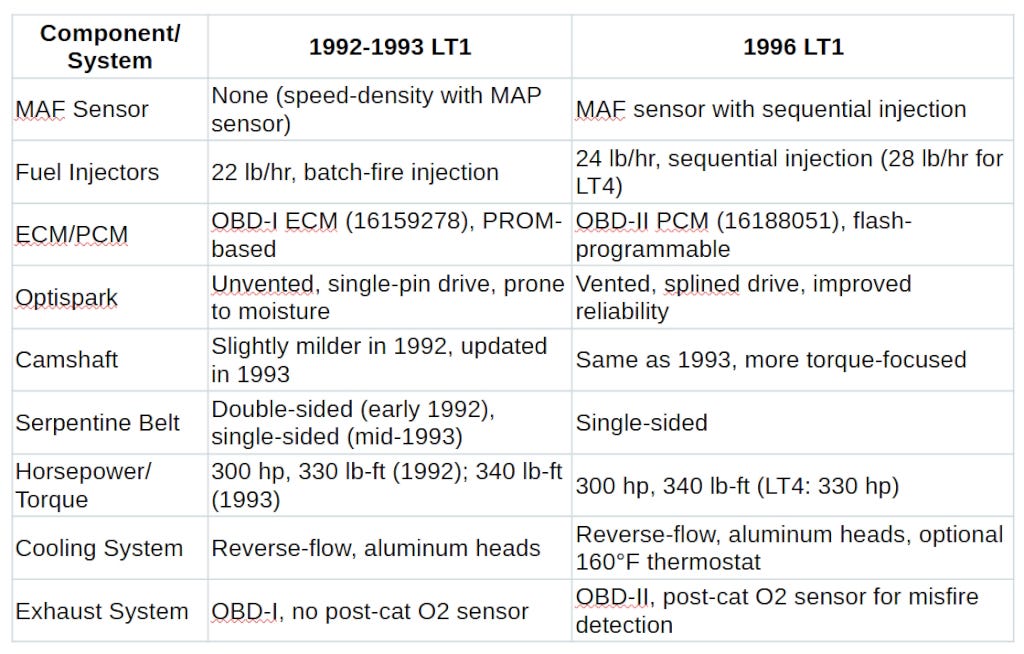
Practical Implications:
Performance: The 1996 LT1’s sequential injection and MAF system provide slightly better throttle response, fuel economy, and emissions compliance compared to the 1992–1993 speed-density system. The torque increase in 1993–1996 (340 lb-ft) offers a marginal low-end performance advantage.
Reliability: The vented Optispark in 1996 is a significant improvement over the 1992–1993 unvented design, reducing ignition-related issues. The OBD-II PCM in 1996 also offers better diagnostics, making it easier to troubleshoot issues.
Modifications: Upgrading a 1992–1993 LT1 to 1996 specifications (e.g., MAF, sequential injection, vented Optispark) is possible but requires significant changes, including wiring harness updates, injector rewiring, camshaft/drive modifications, and PCM reprogramming. Such conversions are complex and typically not cost-effective without professional tuning.
Maintenance: The 1996 LT1’s MAF sensor requires periodic cleaning to avoid performance issues, while the 1992–1993 speed-density system is less sensitive to air filter contamination but more prone to vacuum leak issues. Optispark maintenance (cap and rotor replacement) is critical for both, but more frequent on 1992–1993 models.
Notes: The 1996 LT4 engine, available in special-edition Corvettes (e.g., Grand Sport, Collector’s Edition), is a distinct variant with higher output (330 hp), different heads, intake, and 28 lb/hr injectors. If your 1996 Corvette is an LT4, these differences apply instead of the standard LT1 specifications.
Always verify part numbers and compatibility when sourcing replacement components, as differences in transmission type (manual vs. automatic) may require specific PROMs or Memcals for the ECM/PCM.
You must be logged in to post a comment.